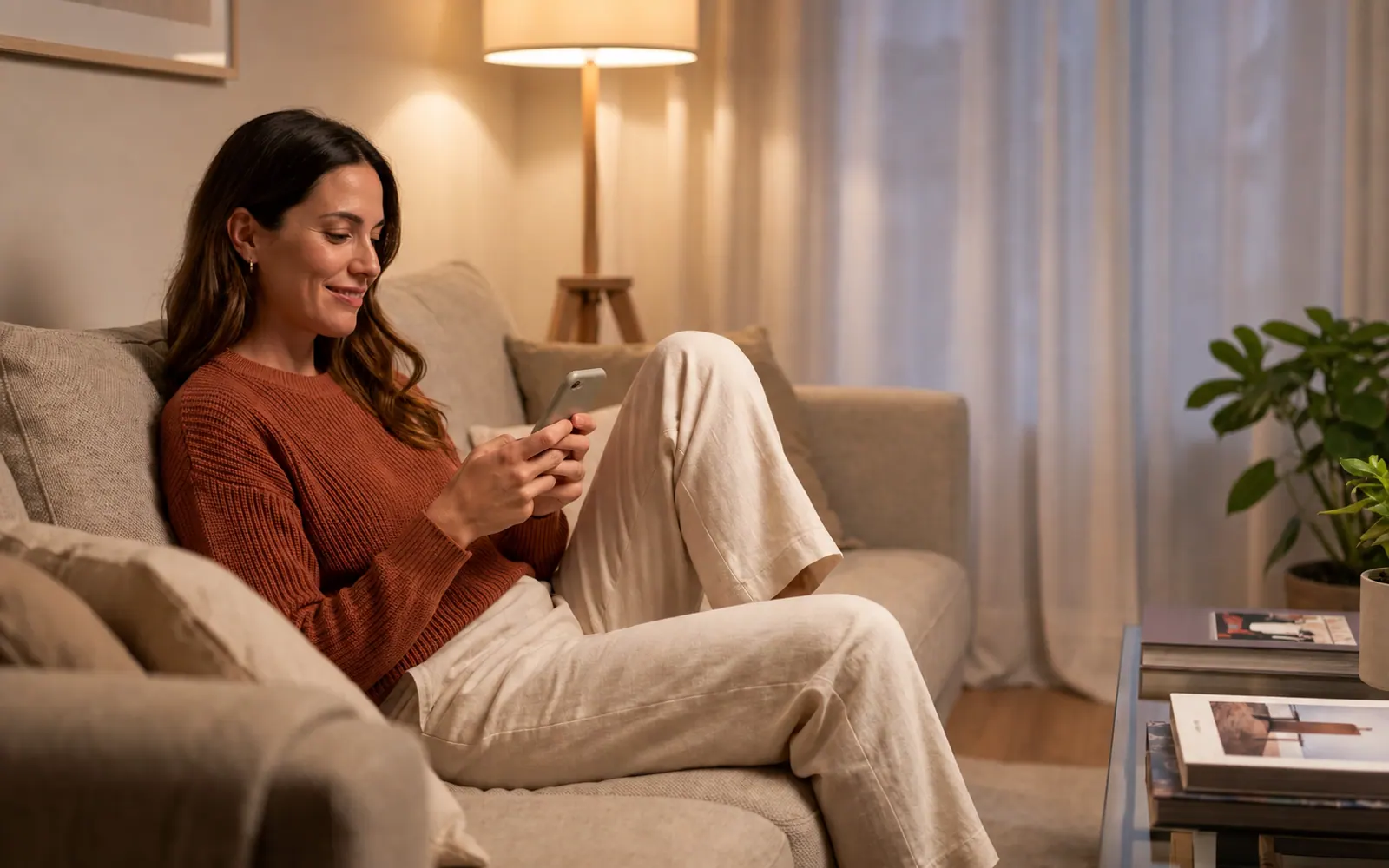
Who answers my center's WhatsApp at ten at night?
Messages don't arrive when your center is open: they arrive when your client has time to write. At night, on Sunday, in the middle of rush hour. And right then, with the shutter down or the team in a treatment room, almost no one answers. That silence shows up in no report, yet it decides bookings somewhere else. This article is about who can answer those hours, and how far an AI should go without pretending to be something it isn't.
In this article7 sections
The ten-at-night message nobody answers
It's ten at night. A client just saw your post, opens WhatsApp, and writes: 'Do you have a slot this week for a facial?'. There's no one at your center: the shutter is down and the phone is in a drawer. The message sits there. In the morning, between the first client and the ringing phone, someone might see it by mid-afternoon. Or maybe not. By then she's already booked somewhere that did answer.
This is one of the quietest costs at an aesthetic center: not the client who complains, but the one who writes once, gets no reply, and doesn't try again. It shows up in no report because it never became an appointment. Every incoming message left unanswered is a booking decided in the window when you're not there, and that window —nights, Sundays, rush hours— is exactly when the most people have time to message you.
What isn't answered isn't measured
A client who writes after hours and gets no reply rarely insists. They quietly go to whoever answered. Because it was never an appointment, the loss shows up in no statistic: it simply didn't happen.
When messages really arrive (and why it hurts)
Messages aren't spread evenly across business hours. They arrive when people can write, not when you can reply. Evening, after dinner, is a natural time to look at your phone and decide to take care of yourself. Sunday, with the week ahead, is when many people plan. And the center's rush hour —when your team has their hands in a treatment room— is exactly when WhatsApp fills up and no one can stop to answer.
WhatsApp for aesthetic centers is an intimate, immediate channel: whoever writes expects a reply soon, like in any chat. That's its power and its demand. An email can wait until tomorrow; a WhatsApp left unanswered for hours feels like a closed door. The windows when no one is around aren't minor gaps: they often concentrate a good share of the inquiries that could turn into appointments.
- Evening: after dinner, when people look at their phone calmly and decide to take care of themselves.
- Sunday and holidays: when people plan the week and the center is closed.
- Rush hour: when your team is in a treatment room and no one can stop to reply.
- Midday and shift changes: small windows where a message goes unread.
What a 24/7 AI receptionist does
The answer to 'who replies at ten at night' doesn't have to be a person working a night shift. An AI receptionist handles your WhatsApp when your team can't: it reads the message, understands what it asks, and replies in the moment, with your center's real information. It isn't a voicemail saying 'we'll get back to you during business hours'; it's a conversation that moves forward.
What matters is that it doesn't stop at informing. Within the same chat it can resolve the inquiry and carry it all the way to the appointment: it checks slots, books, and if the client needs to move an existing appointment, it reschedules. From message to booking without leaving WhatsApp and without anyone on the team having to be awake. When morning comes, those conversations aren't a pile of messages to answer: they're appointments already in your calendar. And once they're on the calendar, keeping them is the next front: that's where your strategy to reduce no-shows comes in.
- Replies instantly with your center's real information: services, prices, and availability.
- Books new appointments by checking the real slots in your calendar.
- Reschedules or edits existing appointments within the same conversation.
- Collects the data you need before the visit, without pulling the client out of the chat.

Where the AI ends and your team begins
A useful AI receptionist isn't the one that tries to solve everything, but the one that knows when it shouldn't. Configurable human escalation is the piece that makes this trustworthy: you define when the AI must stop and hand the conversation to a person, who it notifies first, and through which channel. A delicate clinical question, a complaint, a case that falls outside the script: the AI recognizes it and passes it on instead of improvising.
This way, the AI doesn't replace your team: it takes the repetitive load off them and hands over, already organized, what genuinely needs a person. In the morning your front desk doesn't start by putting out overnight fires, but by handling the few conversations flagged for human review, with all the context in front of them.
The AI knows its place
The value isn't the AI answering everything, but answering what it can and escalating what it should. Good escalation turns the AI into the front line of your reception, not a wall between the client and your team.
What the AI doesn't do (and why that's an advantage)
The reasonable fear with any AI is that it answers just anything in your name. That's why where it gets what it says matters so much. A serious AI receptionist doesn't improvise: it draws on its own knowledge library —your website, your documents, your catalog of services and prices— and replies with that information, not with whatever 'sounds right'. If it doesn't know, it doesn't make it up: it escalates.
And there are lines it won't cross. It doesn't make diagnoses or give clinical advice: that's your professional team's job, not an assistant's. It doesn't invent prices or promise results. Combined with human review and approval of what the AI proposes, this keeps the reins in your hands. Honesty about its limits isn't a weakness of the system: it's what lets you leave it handling your channel without fear.
What changes in practice
Putting an AI receptionist on your WhatsApp doesn't just change the nights: it changes the feeling that the center 'is always there'. Whoever writes gets a reply, books if they want, and perceives an attentive business, even with the shutter down. And your team stops carrying the weight of pending messages every morning. It's the other side of the messages you send: if appointment reminders by WhatsApp are your outgoing voice, this handles what comes in when no one's there.
It isn't magic and it doesn't replace human warmth in the treatment room; it's covering the window where today there's no one with something better than silence. If you want to see the full channel, the 5 ways to use WhatsApp guide walks through other uses beyond after-hours support.
Typical center (illustrative figures, not measured)
Imagine a center that hypothetically receives a notable share of its messages outside reception hours. If those messages today wait until morning and some get lost, covering that window with an immediate reply could recover appointments that were previously being decided elsewhere. The figures and proportions are illustrative to explain the mechanism, not a result measured in Qleven.
What if your center stopped having invisible leaks?
We show you Qleven working on your center's real operations. No commitment, in 15 minutes.
See Qleven in your center · 15-min demoFrequently asked questions
Does the AI receptionist replace my front desk?
Where does the AI get its answers? Can it invent prices?
Can it actually book appointments, or does it only reply to messages?
What happens if a client asks something clinical or sensitive?
Keep digging deeper
The Qleven features that solve what you just read about.
Continue with these reads
Selected by topic affinity and the operational workflow they share.